
Ostomy Adhesive Options in ConvaTec's Product Line Up
Posted by Written by Parthenon's product team, in consultation with our ostomy care advisors on 22nd Oct 2026
Three Steps to the Right Adhesive: A Practical Look at Convatec’s Selection Guide
Ask an ostomy nurse what separates a good pouching experience from a frustrating one, and the answer is often the barrier adhesive. It determines how long the system stays sealed, how well skin copes with moisture, and how comfortable removal is. Convatec’s adhesive selection guide organizes those choices into a simple sequence, and it is worth walking through.
Why it matters
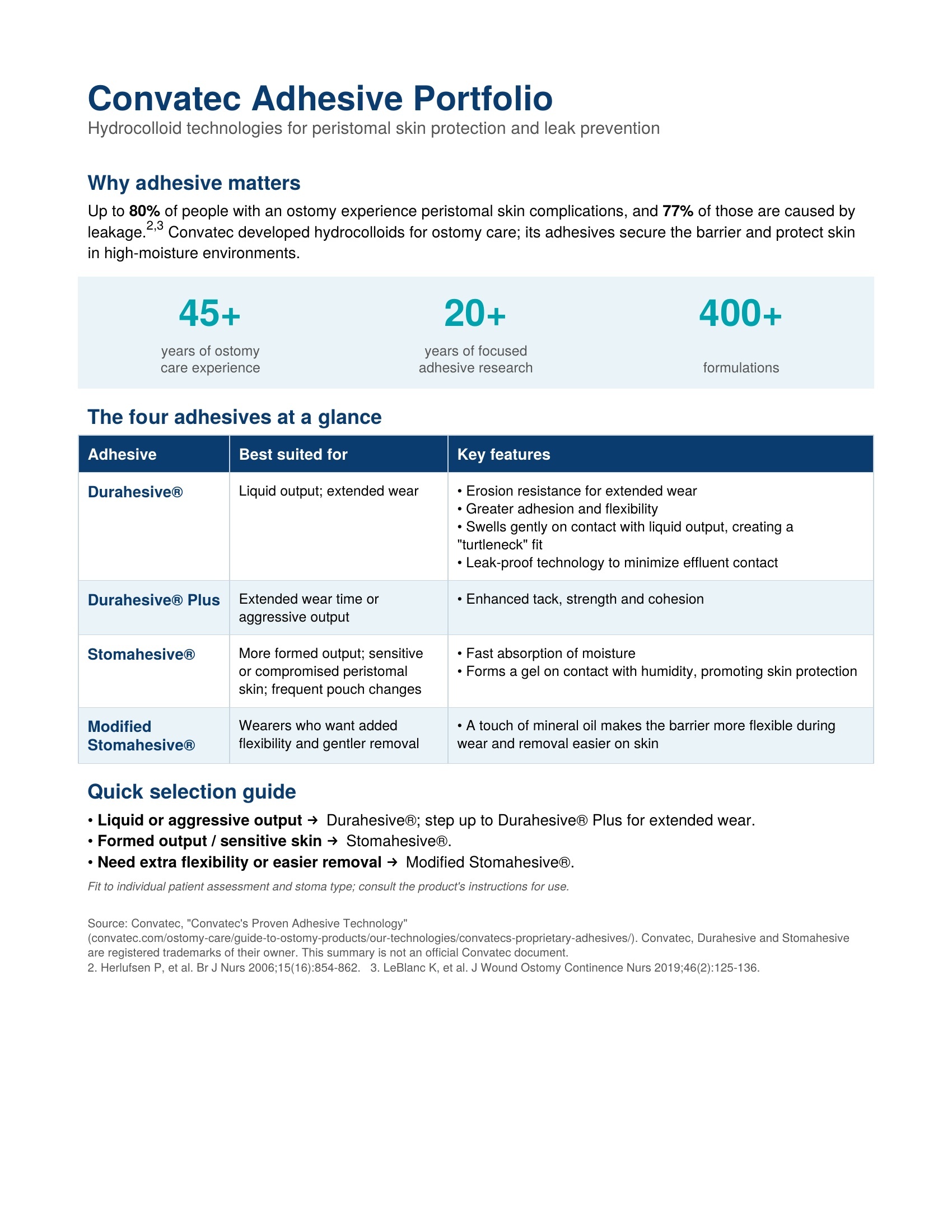
Up to 80% of people living with an ostomy experience peristomal skin complications, and about 77% of those are caused by leakage. A better-matched adhesive is one of the most direct ways to reduce that risk. Convatec’s hydrocolloid adhesives draw on more than 45 years of ostomy care experience, over 20 years of adhesive research and more than 400 formulations.
Step 1: Identify adhesive performance needs
The guide starts with the adhesive, not the pouch. Three questions drive the choice: how much moisture exposure there will be, how long the system needs to stay on, and what removal experience the patient prefers.
Convatec’s four adhesives sit on a spectrum from formed output to liquid or urine output:
Modified Stomahesive® offers balanced adhesion with comfort-focused removal. It rates highest for ease of removal and lowest for moisture handling, which suits patients whose priority is gentle changes.
Stomahesive® provides reliable hydrocolloid adhesion for routine wear. It sits toward the formed-output end, with moderate moisture handling and ease of removal.
Durahesive® gives higher-moisture support for sustained adhesion. It is a step up in moisture handling and wear time, with removal that needs a little more care.
Durahesive® Plus is optimized for liquid or urine output, where maximum moisture handling and barrier security are required. It tops the moisture and wear-time ratings.
The trade-off runs in one direction. As moisture handling and wear time increase, ease of removal decreases. A strong grip is what holds up against liquid output, so the choice is about fit rather than “best.” The guide also notes that performance may vary with individual needs, output and skin condition, which is a good reminder to treat the first choice as a starting point.
Step 2: Choose the ostomy system
Once the adhesive is chosen, the next decision is one-piece or two-piece, based on care goals and patient preference. Availability maps neatly to Convatec’s current platforms:
- Esteem™+ (one-piece) is available with all four adhesives.
- Esteem Body™ (one-piece) is available with Modified Stomahesive® and Durahesive®.
- Natura™ (two-piece) is available with Stomahesive® and Durahesive®.
Esteem synergy™ and ActiveLife® appear in the guide as legacy platforms. If a patient is already on one of them, the guide’s availability notes are a useful reference when discussing a move to a current system. Durahesive® Plus is currently available on Esteem™+, so a patient who needs it and prefers a two-piece system would need to talk through those options with their clinician.
Step 3: Select the pouch option
The final step matches the pouch to output characteristics and lifestyle. The guide lists four options: drainable, closed-end, urostomy and high output. Because the adhesive was chosen first, this step is usually the easiest, since the pouch type tends to follow the patient’s output.
Putting it together
Consider a few typical conversations:
- A patient with formed output who changes often and finds removal uncomfortable may do well starting with Modified Stomahesive® on a one-piece Esteem™+ system.
- A patient with a looser output who wants a two-piece system might look at Durahesive® on Natura™, then review wear time at follow-up.
- A patient with a urostomy or very liquid output, where leaks keep recurring, is the situation Durahesive® Plus is optimized for, paired with a urostomy pouch.
In each case the sequence is the same: need, system, pouch.
The takeaway
The strength of this approach is that it replaces guesswork with a short, repeatable process, and it keeps the conversation focused on what the patient actually experiences: moisture, wear time and removal comfort. Check in after a change or two, and adjust along the spectrum if needed.
This article is a general educational summary based on Convatec’s adhesive selection materials (AP-80063-GBL-ENG-v1, a global document). Product availability and labeling can vary by region, so confirm current options and instructions for use for your market.